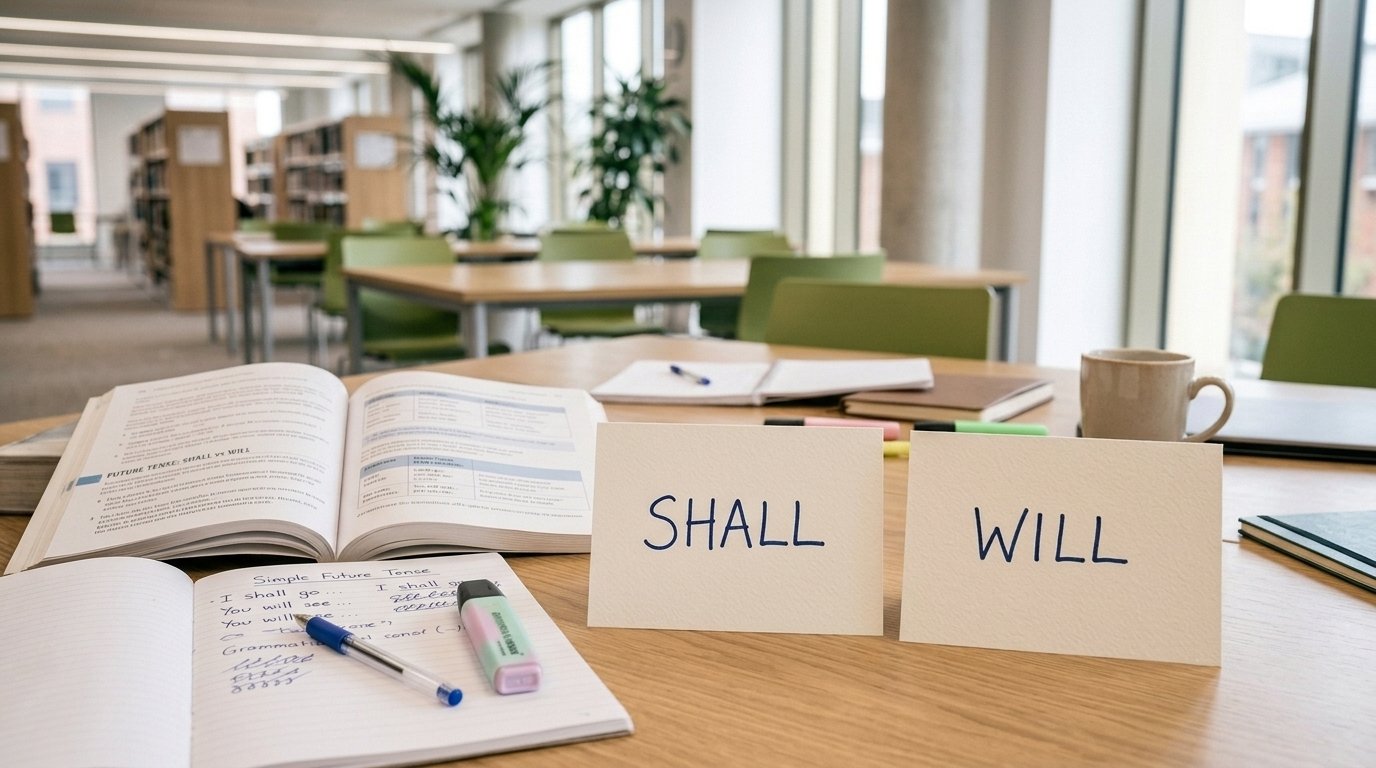
The words shall and will are both used to talk about the future, but they can express different meanings depending on the situation. Understanding the difference between shall vs will helps you speak and write English more naturally. Although both words can describe future actions, they are also used to make offers, ask for suggestions, express intentions, and show formal obligations.
In everyday English, will is generally the more common choice when talking about future plans, predictions, promises, and decisions. Shall is less common in casual conversation, especially in American English, but it is still useful when making suggestions with “I” or “we,” such as “Shall we begin?” It also appears in formal documents, rules, and legal writing. The best word depends on what you want to communicate, the tone you need, and the context of your sentence.
Quick Answer: Shall vs Will
Shall and will can both refer to the future. Will is commonly used for predictions, promises, decisions, and future actions. Shall is often used to make suggestions or offers with “I” and “we,” as in “Shall we go?” It also appears in formal and legal English to express obligations or requirements.
Why Do People Confuse Shall and Will?
People confuse shall and will because both words can describe future events. In many modern English sentences, they can communicate nearly the same basic meaning.
For example:
- I will call you tomorrow.
- I shall call you tomorrow.
Both sentences refer to a future phone call. However, the second sentence may sound more formal, old-fashioned, or literary in everyday conversation.
Another reason for the confusion is that traditional grammar books sometimes teach different rules for shall and will depending on the subject. Modern English usage is more flexible, so understanding the purpose of each sentence is more helpful than memorizing a strict rule.
What Does Shall Mean?
Shall is a modal verb used to express suggestions, offers, formal requirements, and, sometimes, future actions. It is particularly common in questions beginning with “I” or “we” when someone wants to suggest an action or ask what should happen next.
Common Uses of Shall
1. Making suggestions
Use shall to suggest doing something together.
- Shall we watch a movie?
- Shall we start the meeting?
2. Making offers
Use shall when offering to do something for someone.
- Shall I carry your bag?
- Shall I open the window?
3. Expressing formal requirements
In legal documents, contracts, and official rules, shall may express a duty or requirement.
- The applicant shall provide accurate information.
- Each member shall follow the rules.
The precise meaning of shall in legal writing depends on the document and its interpretation.
4. Expressing future actions
Shall can also refer to future events, especially in formal or traditional English.
- We shall meet again.
- I shall return before sunset.
These uses are grammatically correct, although will is usually more natural in ordinary modern conversation.
What Does Will Mean?
Will is a modal verb commonly used to express future actions, predictions, promises, willingness, and decisions. It is one of the most frequently used ways to talk about the future in everyday English.
Common Uses of Will
1. Talking about future actions
Use will to describe something that is expected to happen.
- I will visit my grandmother tomorrow.
- They will arrive in the evening.
2. Making predictions
Use will when predicting what may happen.
- I think it will rain tonight.
- She will probably pass the exam.
3. Making promises
Use will to promise that you will do something.
- I will always support you.
- I will help you with your homework.
4. Making decisions
Use will when deciding to do something, especially at the moment of speaking.
- The phone is ringing. I will answer it.
- I am tired, so I will take a short break.
5. Expressing willingness
Use will to show that someone is willing to do something.
- I will help you move the furniture.
- He will gladly explain the lesson.
Shall vs Will: Comparison Table
| Feature | Shall | Will |
|---|---|---|
| Main use | Suggestions, offers, formal requirements | Future actions, predictions, promises |
| Everyday conversation | Less common in many contexts | Very common |
| Making suggestions | “Shall we leave?” | “Will we leave?” asks about the future |
| Making offers | “Shall I help?” | “Will I help?” usually asks about willingness or a future action |
| Promises | Possible, but often formal | Very common |
| Formal writing | Used in some rules and legal documents | Also used in formal writing |
| American English | Less common in ordinary speech | Common |
| British English | Common in certain questions and formal contexts | Common in everyday speech |
The key difference is not simply future tense versus future tense. It is how the speaker uses the word to communicate a suggestion, intention, prediction, offer, or requirement.
When Should You Use Shall or Will?
Choose the word that best matches your intended meaning.
Use Shall When Making a Suggestion
Use shall when asking someone whether you should do something together.
Examples:
- Shall we have lunch now?
- Shall we invite our friends?
Use Shall When Offering Help
Use shall to ask whether the other person would like you to do something.
Examples:
- Shall I get you some water?
- Shall I book a taxi for us?
Use Shall in Formal Requirements
Use shall when a formal rule or contract expresses an obligation, where that interpretation is intended.
Examples:
- The employee shall protect confidential information.
- The tenant shall pay the rent on time.
For important legal documents, the wording should clearly express the intended obligation rather than relying on shall alone.
Use Will for Future Plans and Actions
Use will when describing something you expect or intend to happen.
Examples:
- I will finish this project tomorrow.
- We will visit London next summer.
Use Will for Predictions and Promises
Use will when predicting an event or promising an action.
Examples:
- You will enjoy this book.
- I will never forget your kindness.
12 Examples of Shall vs Will in Sentences
These examples show how the two words work in different situations.
1. Shall: Shall we go for a walk?
Will: We will go for a walk after dinner.
2. Shall: Shall I open the door?
Will: I will open the door for you.
3. Shall: Shall we begin the lesson?
Will: The lesson will begin at nine o’clock.
4. Shall: Shall I call the doctor?
Will: I will call the doctor now.
5. Shall: Shall we meet tomorrow?
Will: We will meet tomorrow.
6. Shall: Shall I make some tea?
Will: I will make some tea for everyone.
7. Shall: We shall overcome this challenge.
Will: We will overcome this challenge.
8. Shall: The supplier shall deliver the goods by Friday.
Will: The supplier will deliver the goods by Friday.
9. Shall: Shall we take a different route?
Will: We will take a different route if traffic is heavy.
10. Shall: Shall I help you with your bags?
Will: I will help you with your bags.
11. Shall: We shall remember this special day.
Will: We will remember this special day.
12. Shall: Shall we watch the next episode?
Will: We will watch the next episode tonight.
Notice that shall often invites a decision or proposes an action, while will commonly states what someone expects, intends, or promises to do.
Common Mistakes With Shall and Will
Learning these common mistakes can help you use both words more confidently.
Mistake 1: Using Will Instead of Shall for Every Suggestion
Incorrect for the intended offer:
– Will I open the window?
More natural when offering:
– Shall I open the window?
“Will I open the window?” is grammatically possible in a different context, but it does not naturally make the same offer.
Mistake 2: Thinking Shall Is Always Required for I and We
Some traditional grammar lessons teach that shall should be used with “I” and “we,” while will is used with other subjects. This is not a general rule of modern English.
Natural modern examples include:
- I will call you later.
- We will see you tomorrow.
- They will arrive soon.
Mistake 3: Thinking Shall and Will Always Mean Exactly the Same Thing
The words can overlap when describing future actions, but their functions can differ.
- Shall we eat now? — A suggestion.
- Will we eat now? — A question about what is going to happen.
Mistake 4: Using Shall Too Often in Casual Conversation
Although shall is correct in many contexts, it may sound formal or unusual if used for every future action.
Instead of “I shall call you tonight,” most speakers would naturally say, “I will call you tonight.”
Mistake 5: Assuming Shall Always Creates a Legal Obligation
In legal and formal writing, shall may express an obligation, but its exact interpretation depends on the wording, context, and applicable rules. Clear drafting is important.
Memory Trick: How to Remember Shall vs Will
Use this simple memory trick:
- Shall = Suggest or offer.
- Will = Future, promise, or prediction.
Remember these two examples:
- “Shall we go?” means you are suggesting going together.
- “We will go” means you are stating that you intend or expect to go.
This trick works well for everyday English, although both words have additional uses in formal and traditional writing.
Shall vs Will in American and British English
Both American and British English use shall and will, but their everyday patterns differ.
American English
In American English, will is the usual choice for ordinary future statements.
Examples:
- I will see you tomorrow.
- We will finish the work soon.
Shall is still used in expressions such as “Shall we begin?” and in some formal or legal contexts, but it is less common in casual conversation.
British English
British English also commonly uses will for future actions. However, shall remains familiar in questions and expressions such as:
- Shall we go for a walk?
- Shall I make you a cup of tea?
These expressions are polite and natural in many British English contexts.
Important: Neither variety requires speakers to use shall with every sentence containing “I” or “we.” The choice depends on meaning, context, and personal style.
Similar Words Related to Shall and Will
Several other words can help you express the future, suggestions, or obligations. However, they are not always interchangeable with shall and will.
- Should: Expresses advice, expectations, or what is appropriate. Example: You should get some rest.
- Must: Expresses strong necessity or obligation. Example: You must wear a seat belt.
- May: Expresses permission or possibility. Example: It may rain later.
- Might: Expresses possibility or uncertainty. Example: We might visit tomorrow.
- Going to: Often expresses an existing plan or a prediction based on present evidence. Example: I am going to study tonight.
- Would: Often expresses hypothetical situations, polite requests, or future actions viewed from the past. Example: I would help if I had time.
These words have different grammatical functions, so choosing the right one depends on the message you want to convey.
Final Verdict: Shall or Will?
Both shall and will are correct English modal verbs, but they are most useful in different situations.
Use shall when making suggestions with “I” or “we,” offering assistance, or expressing a formal requirement when appropriate. Use will for most everyday future statements, predictions, promises, and decisions.
For example, say “Shall we start?” when suggesting that an activity begin. Say “We will start at ten” when stating a future plan. Understanding this difference will make your English clearer and more natural.
Frequently Asked Questions
1. What is the main difference between shall and will?
The main difference is their typical use. Shall often makes suggestions or offers and appears in formal requirements, while will commonly expresses future actions, predictions, promises, and decisions.
2. Is shall more formal than will?
Generally, yes, in many everyday future statements. Shall can sound formal or traditional, although expressions such as “Shall we begin?” remain natural in ordinary conversation.
3. Should I use shall or will with I and we?
Both are grammatically correct in many contexts. Use will for ordinary future statements, such as “I will call you,” and shall for suggestions or offers, such as “Shall we leave?”
4. Is shall still used in modern English?
Yes. It is used in questions such as “Shall I help you?” and “Shall we begin?” It also appears in formal writing and legal documents, although its use in everyday future statements has declined.
5. Is shall more common in British or American English?
Shall is generally more familiar in certain everyday expressions in British English. American English tends to favor will for ordinary future statements, although both varieties use shall.
6. Can shall and will be used interchangeably?
Sometimes. Both can describe future actions, as in “I shall return” and “I will return.” However, they are not interchangeable in every situation because shall can make suggestions or offers, while will has other common functions.
7. Which is correct: “Shall we go?” or “Will we go?”
Both are grammatically correct, but they usually mean different things. “Shall we go?” suggests going together or asks whether to leave. “Will we go?” asks whether going is expected or will actually happen.
8. Does shall always mean must in legal writing?
No. Shall may express a legal obligation, but it does not automatically mean must in every document. The wording, context, and applicable legal interpretation determine its effect.
Remember This
- Use shall for suggestions: “Shall we begin?”
- Use shall for offers: “Shall I help?”
- Use will for future actions: “I will call tomorrow.”
- Use will for promises: “I will keep my word.”
- Use will for predictions: “It will rain soon.”
When in doubt, will is usually the natural choice for everyday future statements, while shall is especially useful for suggestions and offers.
Conclusion
Understanding shall vs will becomes much easier when you focus on what the sentence means rather than following rigid traditional grammar rules. Both words can refer to the future, but shall is particularly useful for making suggestions, offering help, and expressing certain formal requirements. Meanwhile, will is the more common choice for everyday future actions, promises, predictions, and decisions.
With regular practice, you will recognize the difference naturally. Remember the examples “Shall we go?” and “We will go.” The first suggests an action, while the second states an intention or expectation. Using these patterns in conversation and writing will help you communicate more clearly and confidently.